What's In A Name? (And How To Find The Right One For Your Product)
In my 25 years as a food and drink copywriter, I've done a fair bit of naming work. From new brands and products and whole ranges, coming up with names that encapsulate and communicate an idea is a really fun part of the copywriting job.
Most brand names start with a blank page, a brief, and someone staring at a whiteboard. The results usually feel like it. In my experience, the best brand names aren’t invented, they’re found.
Great names don’t tend to come from a brainstorm. They come from digging deep on the subject and putting in the work. Naming is not coming up with a cool sounding word like a team on The Apprentice, nor is it dropping a verb's vowels and using a sexy font (please). It involves listening, connecting, looking for inspiration in every nook and cranny. The best names are already out there, waiting to be found.
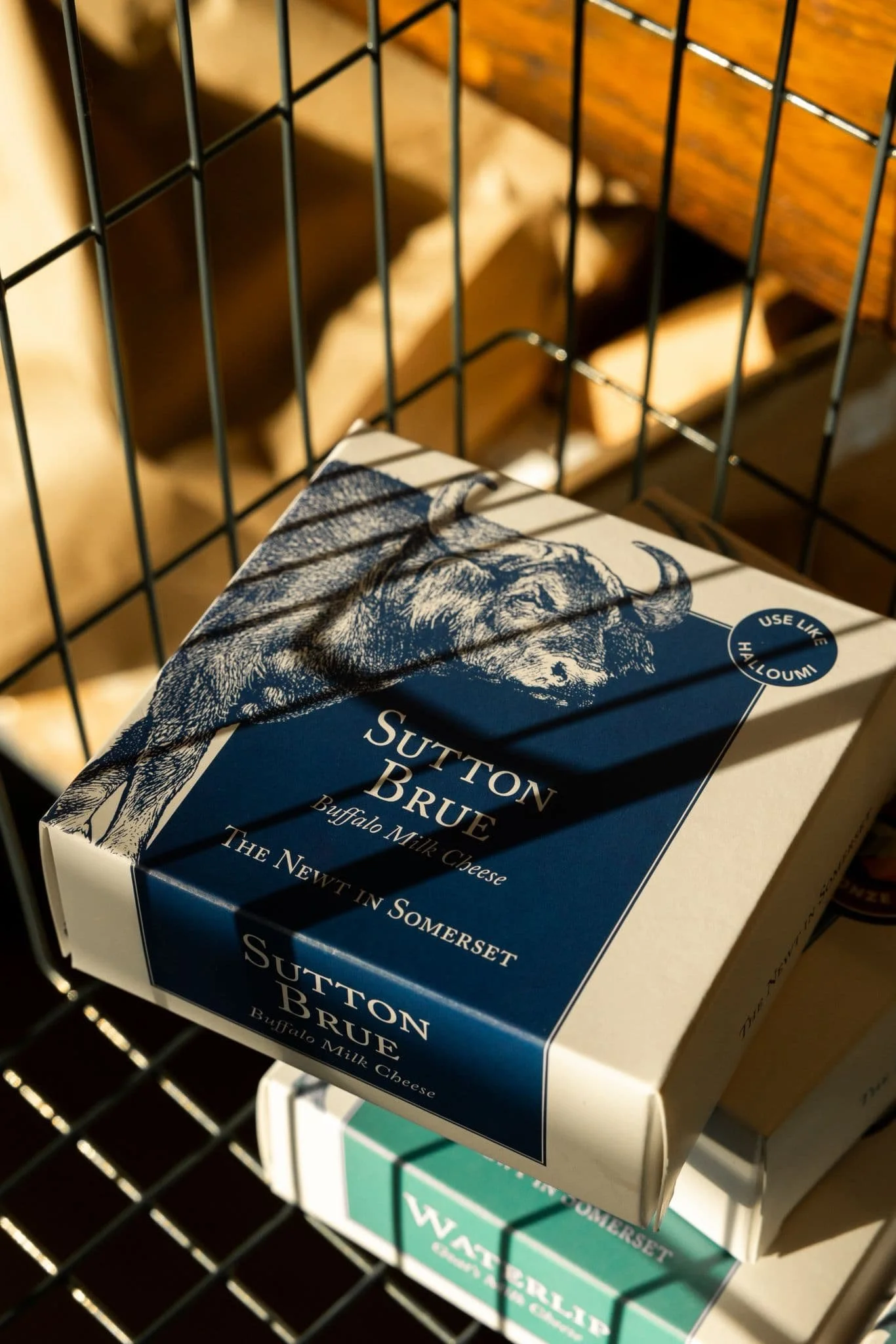
Sutton Brue and Waterlip cheese packaging for The Newt.
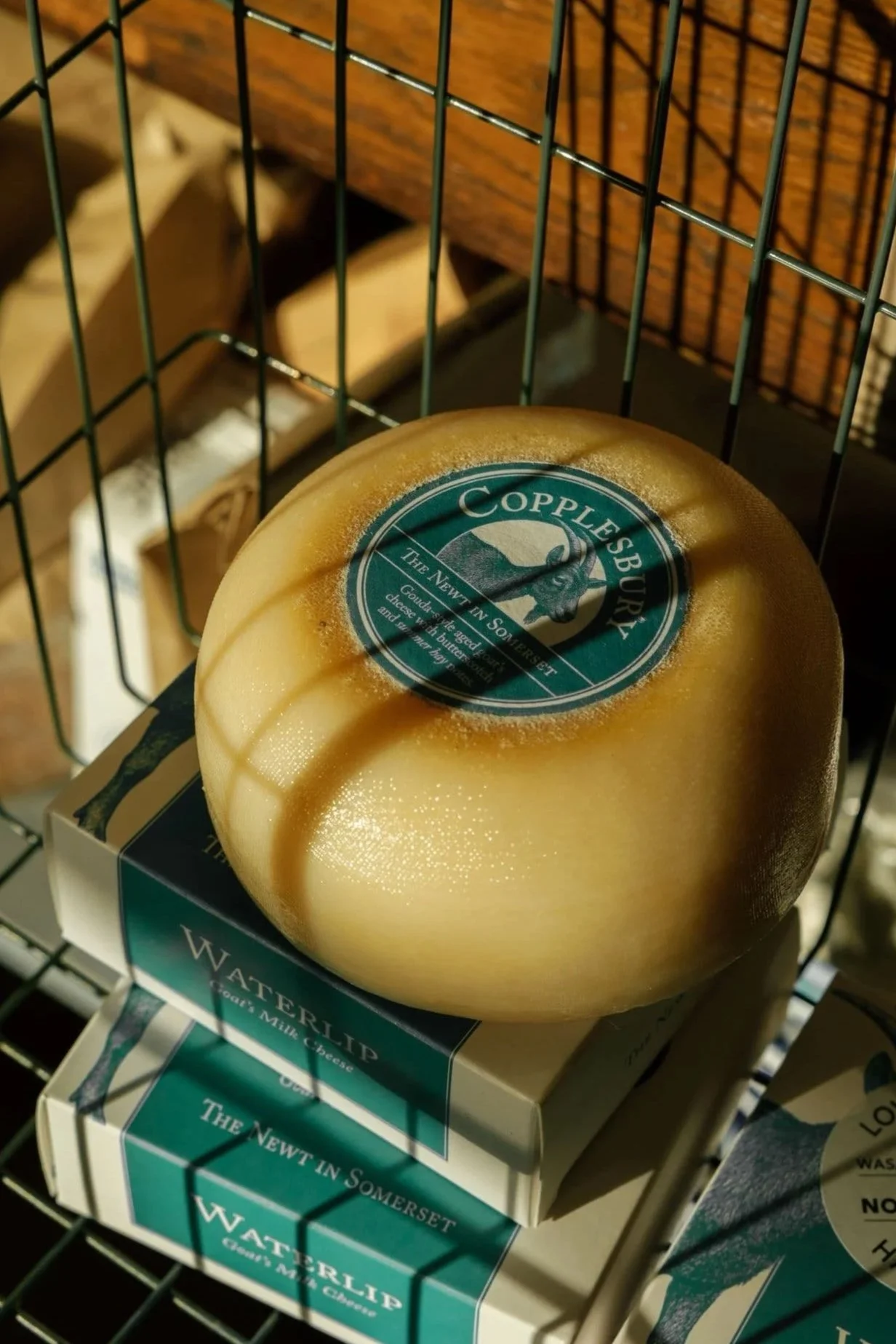
Copplesbury and Waterlip cheese labels for The Newt.
The Creamery at Castle Cary
The brief came with a complication. The Newt in Somerset wanted to make their own feta and halloumi, but both cheeses have Protected Designation of Origin status. Unless made in Greece or Cyprus, respectively, you can’t use those name. So before we could even think about naming, we had a legal necessity: these cheeses needed entirely new identities.
I could have gone down the pun route. Food naming is littered with puns – some charming, most forgettable, and many that undervalue the product. These were exceptional handmade cheeses that didn't need cheapening. Factor in that they were to be made exclusively with the Newt's buffalo milk – which meant they were something altogether richer and more distinct than just 'British takes' – and I had some work to do. It was time to go searching.
The Newt's Creamery sits next to Castle Cary train station. Opposite, the river Brue meanders past, and beyond that, a small hamlet is just visible across the fields. The Newt's buffalo herd graze at a farm once called Copplesbury, up the river valley near Bruton. On the road from Castle Cary to Shepton Mallet, there's an enchanting hill called Lamyatt Beacon that soaks up the evening sun. And somewhere in The Newt's historic archives – in old maps, letters and local lore – are centuries of stories waiting to be told.
I named the halloumi 'Sutton Brue' by simply contracting that nearby hamlet and river. It's a name that would not only resonate with Castle Cary residents, it sounds familiar and is redolent of the cheese's character – firm and full, yet soft and pliable at the same time. I named the feta ‘Waterlip’ – lifted from an ancient field title on a beautiful hand-drawn map of Castle Cary. I had no idea it was a real place, as it turns out it is (more on that later), but those two words together, 'water' and 'lip', just summed up the crumbly, salt-brined freshness of The Newt's feta cheese perfectly.
Then a range of goat’s milk cheeses was developed, and with them, more names required.
In my research, one of the archivists mentioned Empress Maud, the medieval 'Lady of the English'. During the period of cicil war known as The Anarchy, Castle Cary was held by noblemen loyal to Matilda's cause, and was twice besieged by King Stephen’s forces, leaving it damaged beyond repair. But they never got Matilda (aka ‘Maud’), and for an impressive ash-ripened goat’s cheese – oozy and blissfully creamy once ripe, yet uncompromising and distinct in its own right – the name felt right. Unique, feminine, and quietly formidable.
Brereton Hill came from two directions at once. Brereton was the engineer (an assistant to Brunel) who designed Castle Cary station – the very building next to which The Creamery stands. ‘Hill’ came from Lamyatt Beacon, the one I often admired on the drive home. I imagined Brereton riding up there to survey the landscape before committing his designs to paper. It seemed right to put him back on that hillside.
Little Prideaux completed the set. The Prideaux brothers opened the original Creamery Milk Factory in the early twentieth century, taking advantage of Castle Cary’s direct line to London to send fresh milk and cheeses up to the capital's markets. For a small, gentle brie-style goat's cheese, ‘Little’ felt right. An affectionate nod to the people who started all of this.
Then I chose ‘Copplesbury’ for the buffalo milk gouda – named after the farm where the buffalos live – and ‘Parson Woodforde’ for its more distinguished aged version. The latter comes from Castle Cary’s very own Samuel Pepys – a man who recorded everything and missed nothing of 18th century Castle Cary life.
Not one of those names came from brainstorms. Every single one was found, refined, paired against tastings of the cheese and market expectations – aiming to bring distinctiveness and regional connection to each product.
Finding the Name in the Story
The Newt cheese names came from history, from archives and old maps and the people who shaped a particular corner of Somerset. But there’s another way to find a name, and it starts in a completely different place.
When Ahmad Tea developed Galerie du Thé – their premium loose leaf sub-brand – they faced a choice. Use the established names that every specialist tea retailer uses: Darjeeling First Flush, Ceremonial Matcha, Fuding White. Recognised, searchable, safe.
Or go all in and create something entirely their own.
They chose the latter, thankfully, and my job was to write the stories behind each tea so compellingly that the names would emerge from them naturally.
The process was unlike anything I’d done before. I’d research each tea – its origin, its producer, its harvest, its character – write a full narrative about it, and then look for the name hiding inside that story.
Sometimes it was obvious. A white tea from Fuding in Fujian province became Emperor’s Peak – a double allusion working quietly beneath the surface. White tea was once the exclusive preserve of Chinese emperors, too precious for ordinary consumption. ‘Peak’ references the jutting formations of Taimu Mountain, where the special, downy white tea buds grow. Neither meaning announces itself, but together they make a name that feels like it has always existed.
Sometimes it required looking harder. A green tea from the remote village of Whangu in Fuliang County, Jiangxi – barely findable on a map, shrouded in mist, picked by hand in small quantities – became ‘Secret Garden’. Two words that capture the inaccessibility and the reward of finding something this rare.
And sometimes it required going to Google Earth and searching over Chinese forests and Himalayan foothills.
A wild-harvested green tea from the mountain valleys near the border of Jiangxi and Anhui provinces – picked by local foragers who return after a few days with beatific smiles and hessian bags stuffed with foraged leaves – needed a name that captured something essential about the place. I found myself zooming in on satellite images of the area, trying to locate the valleys where the tea grows. The forest had a strange, undulating quality – not the flatness of managed plantations, but something older and more irregular, following the shape of the hills beneath.
Folded Mountain.
Both matter-of-fact and simultaneously romantic. The kind of name that sounds like it has always existed in another language and has simply been translated. It arrived not from a brainstorm, but from placing myself in the actual landscape where the tea grows.
A black tea from the Kenyan Highlands became Kirimara Sunrise – Kirimara being the name the local Ameru people give to Mount Kenya. Sunrise alludes to black tea's natural place on the breakfast table. A Rwandan black tea became Bush Tiger, named not for its origin or its flavour but for Rwanda’s indigenous Bush Tiger Mantis – an unexpected choice that somehow captures the wildness of the thing perfectly.
Every name in the Galerie du Thé range started with a story. Not a brainstorm, not a brief, not a blank page. A story.
When the Name Has to Sell
Not every naming brief starts in an archive or ends in a Google Earth rabbit hole. Sometimes the name has to do an immediate commercial job, and elegance has to earn its place at the table.
When The Newt developed a range of premium prepared main courses – chef-led dishes, made in the Farm Kitchen from quality estate-butchered meats, slow-cooked for hours until tender – my instinct was to call it Supper.
It felt right. Supper captured the Georgian heritage of the estate, the unhurried rural idyll, the sense of a proper (but modest, after another grand lunch) meal at a proper table. It was atmospheric, distinctive and completely unlike anything else on the market.
The production team, who had invested significantly in the range and needed it to sell, were less convinced.
They were right to push back. Supper is evocative but it doesn’t tell you anything. Standing in front of a chiller cabinet with thirty seconds to decide, a shopper needs more than atmosphere – they need a reason to reach.
So we looked at the category. M&S Slow Cooked. Waitrose Slow Cooked. The naming convention was already there, doing its functional work. The question was whether we could do the same functional job with more personality.
Low + Slow.
inspired by BBQ culture – the technique of cooking those tougher (but more rewarding) cuts at low temperature for a long time until the collagen breaks down (into flavour) and the meat becomes wonderfully soft. It’s a chef’s term, a cook’s term – the kind of language that signals genuine food knowledge rather than marketing gloss.
It does what the brand elegance of Supper couldn’t quite do – tells you immediately what happened to this food before it reached you, all while carrying enough personality to feel like it belongs on a Newt product. Not as elegant as Supper, but more honest. And on a retail shelf, honesty usually wins.
I named the range. But the name came from the brief, the competition, the commercial reality, and a willingness to let go of the name I loved in favour of the name that worked. That’s commercial naming. It’s rarely the most beautiful answer, but it’s often the most useful.
When It Goes Wrong
Not every naming story ends well.
Early in my career – fresh from the Sainsbury’s Taste the Difference rebrand, and while in my first stint at M&S – I was commissioned to name a premium Scotch whisky for the Taiwanese market. It wasn’t the most inspirational brief, and it had an unusual constraint: no overtly Scottish references. No Lochs. No McClichés. No tartan. The client wanted something that said whisky without saying Scotland – the polar opposite of every blended Scotch on the market.
I was, at that point, a relative whisky novice. So I did what I always do when a brief takes me somewhere unfamiliar. I went to the library.
I read about the distilling process from the beginning. The malting, the mashing, the fermentation, the distillation, the maturation. I read tasting notes. I read histories. I looked for the language that exists inside whisky – the technical terms, the archaic words, the names of things that most drinkers never encounter – and asked myself which of them could stand alone as a brand name.
The Rummager stopped me in my tracks. It’s the name for a chain mechanism inside the still that disturbs the liquid during distillation, preventing it from burning on the copper. As a name it struck me as mysterious, playful, slightly archaic, suggesting both craft and something slightly dangerous – it felt right. It also reminded me of The Who song The Seeker, and something rang true for the corporate Taiwanese businessman. Whisky without Scotland. Process without cliché.
I submitted a list. The Rummager was on it. So was Angel's Share, Middle Cut, Corryvreckan and Saltire, these latter words Scottish in original by stripped of its explicit national identity, just word with an ancient, slightly heraldic quality that could belong anywhere. OK, in hindsight it wasn’t the best list of suggestions and if I had another crack at it today it would look for different. But there was some potential there.
In the end the client went with Prospect.
It wasn’t one of mine. And, to me, it screamed bourbon – all sweet coconutty oak and a distinct lack of complexity.
Some clients choose the right name. Some don’t. That’s the reality of commercial naming – you can find the perfect answer and still watch someone pick the wrong one. It doesn’t mean the process failed. It means naming, like all creative work, involves a client who has the final say. You do the work. You find the name. Then you let go.
The Name That Was Already There
I want to end with a coincidence. Or perhaps not a coincidence at all.
When I was working through the ancient maps of Castle Cary in The Newt’s archives, looking for names for the new cheese range, I came across a field name that stopped me cold.
Waterlip.
I had no idea what it meant. I had no idea if it was a real place or simply the name a long-ago farmer had given to a particular piece of river-edging land. It sounded like something from a folk tale – elemental, slightly mysterious, with a quality that seemed to belong to the landscape rather than to any person. For a feta-style brined cheese made from milk produced a few fields away, it was perfect.
So I used it.
Years later, sitting on the phone to the People Manager of a Somerset food company, she mentioned almost in passing that their farm and offices were located just outside Shepton Mallet.
In a place called Waterlip.
A name I’d lifted from an ancient map. A name I’d assumed was lost to history. A name that turned out to be not just real, but still very much alive – home to a business built around exactly the values I’d spent my career writing about. Provenance. Farming. The stories behind great food.
I don’t know what to make of that. Maybe it’s just a coincidence. Maybe it’s what happens when you spend enough time listening to the landscape – eventually it starts to feel familiar, even the parts you’ve never visited.
The best names aren’t invented. They’re found. Sometimes they find you back.