Dr Strangetimes (Or: How I Learned To Stop Worrying and Love A.I.)
Help! AI Ate My Industry
I set out as a freelance food and drink copywriter in September 2001. Yep, a week before 9/11. Timing is everything, eh? Despite the ominous start, it's been a thrill ride, taking me on many adventures with plenty of highs, and some lows. I got through Covid (luckily, as there was zero help). But then Russia invaded Ukraine the same year ChatGPT was launched. 2022 was just horrible. With AI eating my industry and Russia destroying budgets for so many food producers, I gave up and took a job.
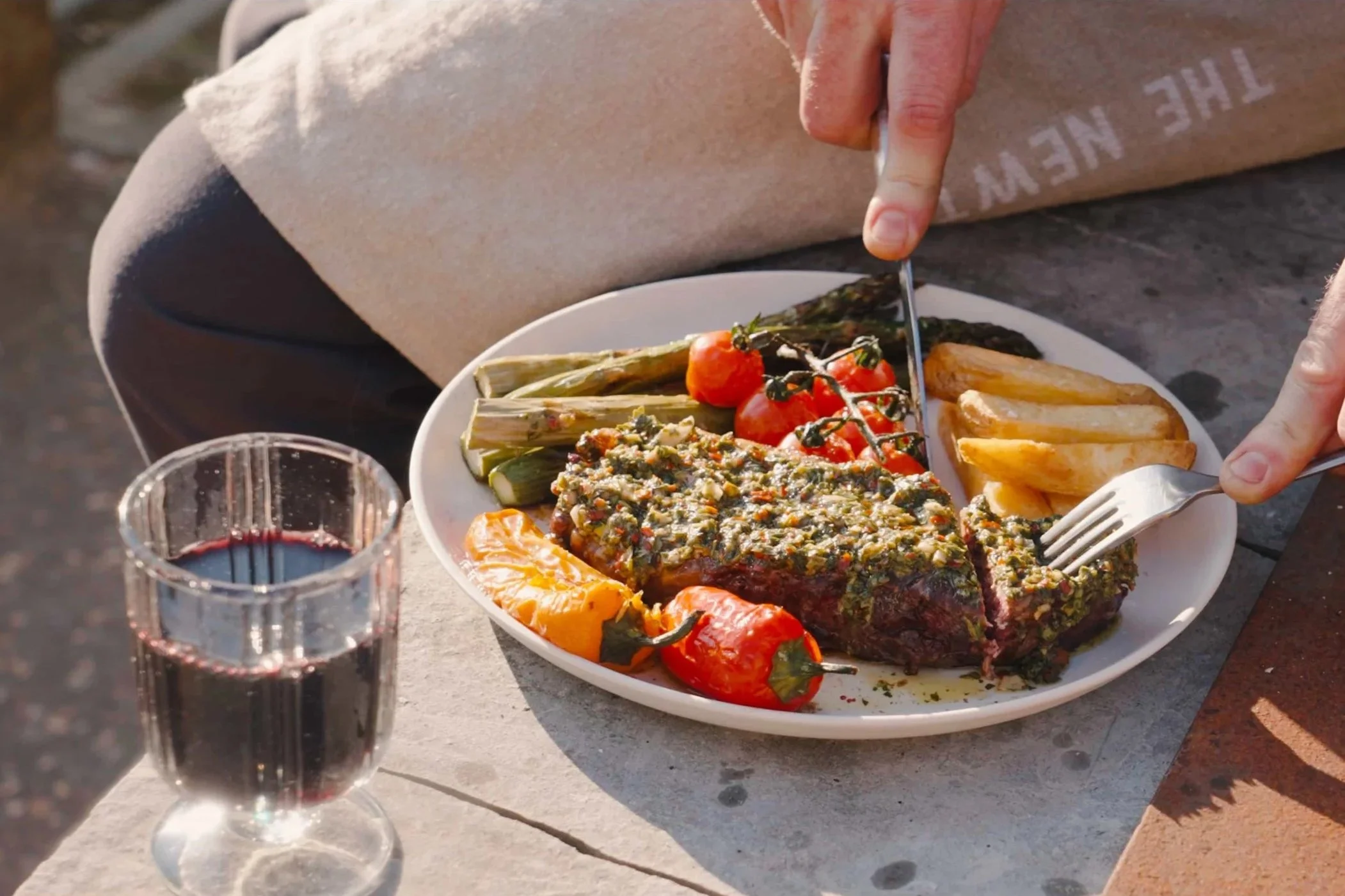
Tucking into a barbecued sirloin at the Newt in Somerset, the finale of a great shoot making content for Father’s Day.
For over 20 years I'd enjoyed a copywriting landscape that suited my food and drink niche. Agencies briefed writers. Brands hired specialists. The food and drink marketing world valued someone who actually knew what they were talking about – who'd stood in a professional kitchen, could tell a caerphilly from a cheddar, and understood why the words on a wine label either make customers place a bottle in their basket, or back on the shelf. Then overnight, it all seemed to fall apart. I swallowed my disappointment and became the in-house marketing copywriter at The Newt In Somerset. And what a joy it was.
When I emerged from full-time employment two years later, everything had shifted once again.
Adrift On a Sea Of Sameness
Not disappeared completely, but shifted. 'Content' had now fully exploded. Every brand, every agency, every startup had struck gold, discovering they could get copy quickly and cheaply with just a prompt. Blog posts. Product descriptions. Social captions. Website 'blurb'. All generated in seconds, with a good-enough veneer of zesty pith, and for so little cost or effort it justified the lack of depth or brand voice in the writing.
The result? All the copy ended up all sounding the same.
I'm not going to pretend I wasn't triggered. Twenty years of building a specialism, and suddenly the internet was full of food and drink copy written by some digital hive mind that had never actually tasted anything. "Artisan." "Carefully crafted." "A celebration of provenance." Words that once meant something, now deployed by an algorithm that had swallowed up all of the existing food copy, but had never actually enjoyed a meal. Grrr.
But here's the thing I didn't expect: the brands that care – and there are thankfully lots of them – quickly woke up from this artificially generated slumber.
The sea of sameness created by AI isn't making good copy less valuable, it's making it more valuable. Because when everything sounds the same, the thing that sounds different stops people in their tracks. And the thing that sounds different is almost always written by someone who actually knows what they're talking about.
What AI Can't Do
I started to see things differently. AI hadn't devalued my specialism, it was creating the conditions in which my specialism was more necessary than ever. The generalists – the writers who've built their careers on being competent across everything – were the ones facing the real squeeze. Because 'competent across everything' is exactly what AI is.
But AI isn't a chef who started working in professional kitchens aged 15. Whose first job was in a traditional butcher's shop, scrubbing the blocks and washing the knives. ChatGPT never watched a larder chef make a pike mousse so fresh the fish were still thrashing around in the sink minutes before being poached. It didn't spend two years immersed in one of Britain’s finest country estates, listening to conversations in the farm shop to understand the tone of voice of its customers, going through ancient agricultural maps to come up with names for its new cheeses, talking to farmers, butchers, gardeners and bakers to write engaging email campaigns and product copy. It didn't spend a month in the wine aisles of M&S conducting research into the psychology of wine label copy for M&S, and discovering why certain words make anxious buyers pick up a bottle and confident ones put it back down.
This kind of immersive knowledge isn't scraped from the internet. It's earned. And I've earned it – through experience, through graft, through tasting.
Why Specialists Are Winning
Once I'd reached this conclusion, something mellowed in how I thought about AI altogether. If it was creating the conditions for specialists to thrive, maybe it could also help this particular specialist get back on his feet.
So I checked my disdain, and started using it. Not to write my copy – that would rather miss the point! – but as a tool to work smarter. With a new website to build, I used AI (Claude, to be precise) to take some of the burden off being a one-man band. Research. Strategy. SEO. The unglamorous admin of relaunching a freelance business after two years out of the game. It helped me build a professional website, without really being a professional website-builder.
How I Learned To Love It
And it was great. Just having someone (something) there to bounce ideas off, to remind me to compress images and suggest the best SEO-friendly titles for each, to make suggestions on structuring my portfolio, meta descriptions, setting up Google Search Console – all of it done collaboratively, efficiently, and with bucketloads of compliments along the way (dang, they really know how to indulge our precious egos, eh?!).
I wasn't relaunching williamthomas.uk despite AI. I was relaunching because of it, and with it.
The irony isn't lost on me. The technology that everyone said would make copywriters obsolete is the same technology reminding the best brands why they need real ones.
So if you want copy that actually tastes of something, you know where to find me.